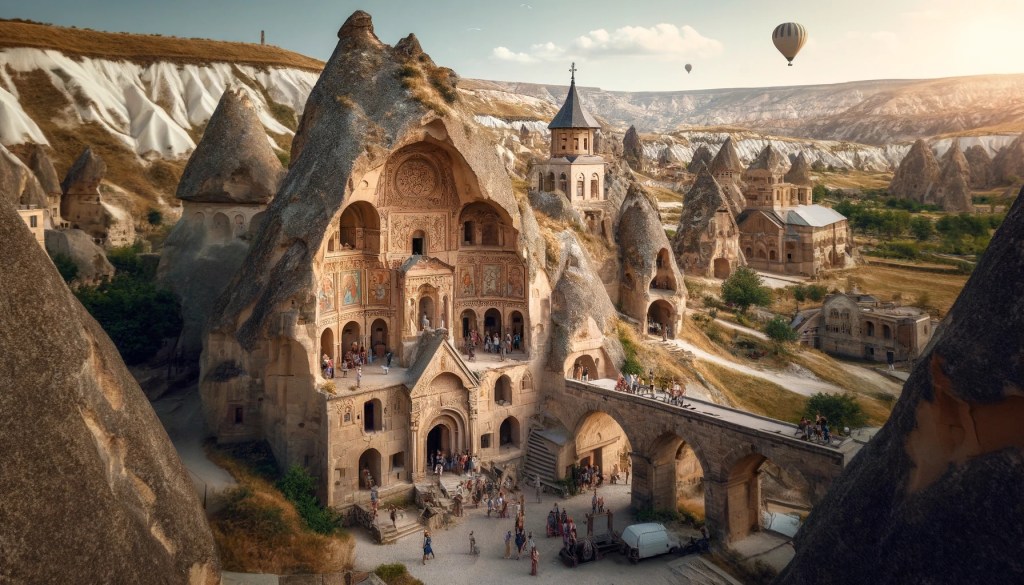
Soğanlı Valley is one of Cappadocia’s quieter cultural landscapes: a place where soft volcanic cliffs, rock-cut churches, dovecotes, village fields, and handmade dolls all sit within the same narrow valley system. It is often described as a peaceful alternative to the busier museum valleys around Göreme, but that simple comparison does not quite do it justice. Soğanlı has its own rhythm, shaped by rural life, Byzantine monastic history, erosion, and the practical needs of people who learned to live with the rock rather than against it.
Located in the Yeşilhisar district of Kayseri Province, southeast of the main Nevşehir-centered Cappadocia routes, Soğanlı rewards travelers who enjoy slow looking. Its churches are smaller and less crowded than the region’s most famous painted sanctuaries, but they are deeply atmospheric. Its walking paths pass gardens, poplars, pigeon houses, cave rooms, and cliff faces where human use and natural geology are layered together.
Where Soğanlı Valley Is
Soğanlı lies in southern Cappadocia, in Kayseri Province, roughly between the highlands around Erciyes and the broader volcanic plateau that defines the region. The nearest district center is Yeşilhisar. From central Cappadocia towns such as Ürgüp, Göreme, or Avanos, reaching Soğanlı usually means traveling south and east across open plateau country, passing villages, farmland, and volcanic horizons along the way.
This location matters. Soğanlı feels more rural than many of Cappadocia’s best-known visitor areas. The valley is not isolated from history, but it is set within a living agricultural landscape rather than a purely museum-like setting. That makes it especially useful for understanding Cappadocia as a region of villages, fields, seasonal labor, and local continuity—not only as a postcard landscape of fairy chimneys.
A Landscape Made by Tuff, Water, and Time
Like much of Cappadocia, Soğanlı’s distinctive forms come from volcanic deposits laid down by ancient eruptions from Central Anatolia’s volcanoes. Over long periods, wind and water cut into layers of soft tuff, carving valleys, slopes, cones, and cliffs. Because this rock is relatively easy to shape, people used it for shelters, churches, storerooms, dovecotes, and monastic spaces.
The valley’s forms are less theatrical than some of the most photographed fairy chimney fields, but they are remarkably expressive. Rock walls show openings at different levels. Some were once religious spaces, while others served practical purposes connected to agriculture and animal keeping. The result is not a single monument but a cultural landscape: nature and human use woven together over centuries.
Rock-Cut Churches and Byzantine Heritage
Soğanlı is best known for its rock-cut churches, many associated with the Byzantine period. These churches were carved into the valley’s soft stone and decorated with frescoes, geometric designs, and devotional imagery. Some paintings are weathered, fragmented, or smoke-darkened, but they still give a strong sense of local Christian life in medieval Cappadocia.
Important churches commonly associated with the valley include Karabaş Church, Kubbeli Church, Yılanlı Church, and other small chapels cut into the slopes. Visitors should expect differences in preservation from one space to another. In some interiors, the architecture itself—the apse, niches, vaulting, and carved surfaces—may be easier to read than the surviving paint. In others, fresco fragments still carry color and narrative detail.
The churches of Soğanlı are valuable because they show how religious life adapted to local conditions. These were not marble basilicas in imperial cities. They were valley churches, made from the material at hand, embedded in a rural environment, and used by communities whose lives likely combined worship, agriculture, refuge, and seasonal movement.
Dovecotes and the Agricultural Side of Cappadocia
One of the most important details in Soğanlı is also one of the easiest to overlook: dovecotes. Across Cappadocia, pigeons were historically valued because their droppings were used as fertilizer for vineyards, orchards, and fields. The niches and carved openings visible in rock faces are reminders of an agricultural system that made careful use of limited resources.
This practical history gives Soğanlı a different kind of depth. The valley is not only about frescoes and churches; it is also about food production, soil fertility, and rural ingenuity. The same soft rock that allowed people to carve sacred spaces also allowed them to support everyday livelihoods. In that sense, Soğanlı helps connect Cappadocia’s famous visual beauty to the practical life that sustained it.
The Village and Its Handmade Dolls
Soğanlı village is also known for handmade cloth dolls, a local craft tradition often associated with women’s work and village identity. These dolls are typically colorful, modest in scale, and made with fabric in styles that reflect local dress and imagination. They became one of the valley’s recognizable cultural symbols, especially as visitors began to arrive in greater numbers.
The dolls are not ancient artifacts in the archaeological sense, but they are part of living heritage. They show how communities respond creatively to change, including tourism, while preserving a sense of local character. For respectful travelers, this is a reminder to see villages as places where people live and work—not just scenic backdrops.
How to Visit Respectfully
Soğanlı is best approached slowly. The valley’s appeal is not only in checking off individual churches, but in walking, pausing, and noticing how different layers fit together. Wear comfortable shoes, because paths can be uneven and dusty. In warm months, bring water and sun protection. In winter or after rain, surfaces may be muddy or slippery.
Inside rock-cut churches, avoid touching frescoes or carved surfaces. Even small contact can damage fragile pigments and stone. Do not add marks, names, or scratches to the walls. If doors or barriers are present, respect them. Some spaces may be closed for conservation, safety, or local management reasons.
Photography should be handled with care, especially near people, homes, and working village areas. Ask before photographing residents closely. The valley is photogenic, but it is also someone’s home landscape. A little patience and courtesy go a long way.
Practical Travel Context
Soğanlı is often visited as part of a broader southern Cappadocia route that may include underground cities, villages, and other historic landscapes. Travel times vary depending on starting point, road conditions, and stops along the way. Because public transport can be limited or indirect, independent visitors should plan carefully and check current local options before setting out.
The best time to visit is generally spring or autumn, when temperatures are milder and the valley colors are especially pleasant. Summer can be hot in the middle of the day, so morning visits are more comfortable. Winter can be quiet and beautiful, though weather may affect walking conditions.
Facilities may be simpler than in Cappadocia’s main tourism centers. This is part of the valley’s charm, but it also means visitors should not assume that every service will be available at all times. Carry essentials, allow extra time, and treat the trip as a rural heritage visit rather than a tightly packaged attraction.
Why Soğanlı Matters
Soğanlı Valley matters because it broadens the story of Cappadocia. It shows that the region’s heritage is not limited to famous viewpoints or large open-air museums. Cappadocia is also made of quieter valleys, small churches, village crafts, agricultural knowledge, and landscapes where history is distributed across many modest places.
For readers planning a thoughtful journey through Türkiye, Soğanlı offers a valuable lesson: some of the richest places are not necessarily the loudest. Its beauty is gentle, its history is layered, and its atmosphere invites attention rather than speed. To understand Cappadocia well, places like Soğanlı are essential.