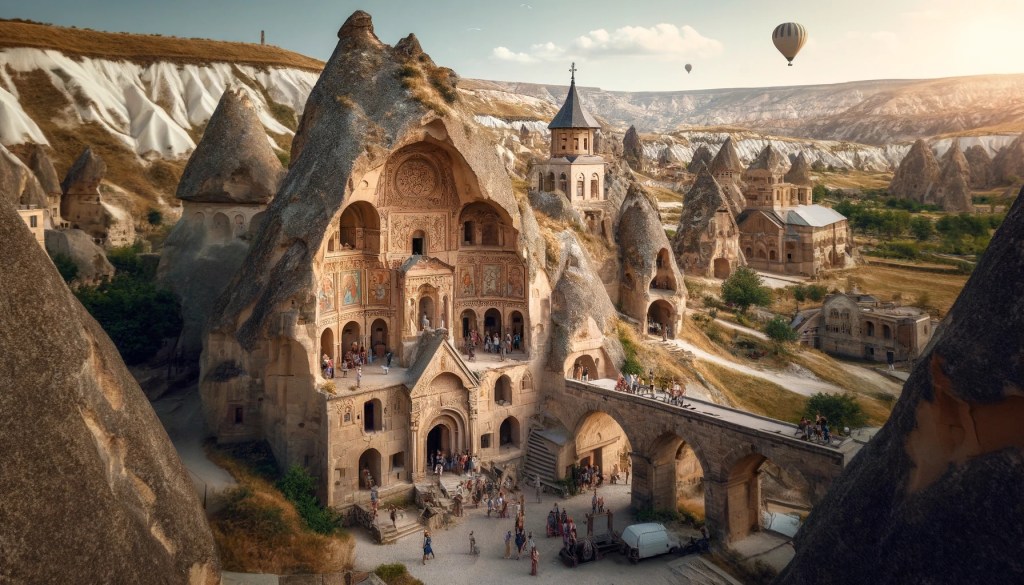
Güzelyurt is one of Cappadocia’s quieter historical settlements, a stone-built town in Aksaray Province where volcanic geology, monastic valleys, Greek Orthodox heritage, and Central Anatolian village life meet in a compact landscape. Many visitors know nearby Ihlara Valley, but fewer pause in Güzelyurt itself. That pause is rewarding: the town offers a grounded way to understand Cappadocia beyond its most photographed fairy chimneys.
Set on the western side of the wider Cappadocia region, Güzelyurt sits among tuff cliffs, cave rooms, old churches, stone mansions, small gardens, and views toward the volcanic mass of Mount Hasan. Its streets are not arranged like a museum display. They feel lived in, layered, and sometimes weathered, which is part of their value. Güzelyurt is a place to walk slowly, notice details, and connect the region’s landscapes with the communities that shaped them.
Where Güzelyurt Fits in Cappadocia
Cappadocia is not a single town or valley. It is a historical and geological region spread across parts of modern Nevşehir, Aksaray, Kayseri, Niğde, and Kırşehir provinces. Güzelyurt lies in Aksaray, close to Ihlara Valley and within reach of Mount Hasan, one of the great volcanoes whose eruptions helped create the soft tuff layers that define so much of Cappadocia’s architecture.
That geology matters. Soft volcanic stone made it possible for people to carve homes, churches, storage rooms, pigeon houses, and monastic spaces directly into the rock. Harder layers resisted erosion in different ways, creating cliffs, slopes, and sheltered pockets. In Güzelyurt, the relationship between stone and settlement is easy to see: houses stand beside caves, streets follow natural contours, and older carved spaces sit beneath or behind later masonry.
From Gelveri to Güzelyurt
Before it became known as Güzelyurt, the town was widely called Gelveri. For centuries it was home to a significant Greek Orthodox, Turkish-speaking Christian community alongside Muslim communities of Central Anatolia. This mixed cultural world shaped the architecture, religious life, food traditions, and local memory of the area.
The population exchange between Greece and Türkiye in the early 20th century changed Gelveri profoundly. Orthodox Christian families left for Greece, while Muslim families from Greece and the Balkans settled in parts of Anatolia, including areas such as this. The result was not a simple break, but a complicated inheritance: churches became historic monuments, houses changed hands, and old place names continued to live in memory even as daily life moved forward under a new national framework.
Understanding this history helps visitors approach Güzelyurt respectfully. The town is not only scenic; it carries stories of devotion, displacement, adaptation, and continuity. Walking here is most meaningful when those layers are acknowledged rather than reduced to a picturesque backdrop.
Monastery Valley and Rock-Cut Sacred Spaces
One of Güzelyurt’s most distinctive landscapes is Monastery Valley, often called Manastır Vadisi. This valley contains rock-cut churches, chapels, cave rooms, and traces of monastic life. Like other Cappadocian valleys, it reflects a long Christian presence shaped by both solitude and community. Monks, clergy, and laypeople used the landscape for worship, shelter, storage, and daily work.
Visitors may notice that many carved spaces are modest rather than monumental. Their power lies in intimacy: small apses, low entrances, soot-darkened surfaces, worn stone steps, and simple chambers cut with practical care. Some churches in the wider Güzelyurt area preserve fragments of painted decoration, while others speak more through their forms than through surviving color.
The valley is also a reminder that Cappadocia’s religious history was not confined to famous open-air museums. Sacred landscapes existed across many villages and valleys, connected by paths, fields, and local communities. Güzelyurt gives a wider frame for understanding that network.
Stone Houses, Courtyards, and Village Architecture
Güzelyurt’s historic houses are built from local stone, often with arched doors, thick walls, courtyards, carved rooms, and decorative details that reward close looking. Some buildings show Greek-influenced masonry traditions; others reflect broader Central Anatolian forms. Many combine carved spaces with built extensions, making the boundary between cave and house feel fluid.
In practical terms, this architecture responded to climate and landscape. Thick stone walls helped regulate temperature through hot summers and cold winters. Courtyards provided working space, shade, and privacy. Cellars and cave rooms offered cool storage. The result was not just attractive design, but a living system adapted to volcanic terrain and rural life.
As in many historic towns, preservation is uneven. Some buildings have been restored, some are in daily use, and others are fragile. Visitors should avoid entering unstable or closed structures, even when they look intriguing from the street. A careful approach protects both personal safety and the town’s heritage.
Mount Hasan and the Geography Behind the Town
Mount Hasan rises south of Aksaray and is one of the volcanic landmarks associated with Cappadocia’s formation. Its presence gives Güzelyurt a powerful geographical setting. On clear days, the mountain’s broad silhouette helps connect the village streets to the deep time of eruptions, ash deposits, erosion, and human adaptation.
This volcanic setting also shaped agriculture. The soils of Central Anatolia vary by altitude, exposure, and water availability, but volcanic landscapes often support distinctive local cultivation where water and shelter permit. Around Güzelyurt, gardens, orchards, grains, legumes, and small-scale food traditions have long been part of the rural economy. The landscape may look dry at first glance, yet valleys and village gardens reveal a more nuanced relationship with water and seasonality.
Food Heritage and Local Taste
Güzelyurt’s food culture belongs to the wider Central Anatolian table: bread, bulgur, legumes, yogurt, seasonal vegetables, soups, pastries, and hearty dishes suited to a continental climate. The town’s former Gelveri community also left traces in memory and recipes carried across the Aegean after the population exchange. Food, like architecture, can preserve connections long after communities move.
For travelers, the best food experiences in places like Güzelyurt are often simple: village bread, a warm soup, local dairy, dried fruits, molasses, or a meal prepared from seasonal ingredients. Rather than chasing a single famous dish, it is worth noticing how food reflects climate, storage methods, farming patterns, and the rhythms of rural hospitality.
Practical Travel Context
Güzelyurt is commonly visited together with Ihlara Valley, Belisırma, Selime, or Aksaray. It can work as a slow half-day stop, but it deserves more time if you enjoy walking, photography, architecture, or religious history. The town is hilly in places, and old stone streets can be uneven, so comfortable shoes are important.
Spring and autumn are especially pleasant for walking, with milder temperatures and softer light. Summer can be hot during the middle of the day, while winter may bring cold weather and occasional snow. Early morning and late afternoon are good times to appreciate the color of the stone and the shape of the valley without rushing.
Because Güzelyurt is a living town, respectful behavior matters. Ask before photographing people closely, avoid climbing on fragile ruins, keep noise low near homes and places of worship, and follow local signs or barriers. If a door, cave, or courtyard is closed, treat it as private even if it looks historic.
Why Güzelyurt Matters
Güzelyurt matters because it widens the story of Cappadocia. It shows that the region is not only balloons, fairy chimneys, or postcard viewpoints. It is also a network of villages, valleys, sacred spaces, volcanic horizons, exchanged communities, and practical rural traditions.
For independent travelers, historians, photographers, and culturally curious readers, Güzelyurt offers a slower kind of Cappadocia. Its beauty is not loud. It is found in carved thresholds, quiet chapels, weathered stone, mountain light, and the knowledge that many generations made a life here by working with the land rather than against it.
Approached with patience, Güzelyurt becomes more than a side trip. It becomes a key to understanding Cappadocia as a human landscape: shaped by geology, faith, migration, memory, and everyday resilience.